Feeds:
Posts
Comments

Archive for the ‘Uncategorized’ Category

No matter how much you may love your home,

right now is this how you’re feeling?

disorder-4073570_1280

You are not alone. Though most of us can remember whining things like,

“Tomorrow is Monday… but I don’t want to go to work.”

“My calendar is so full, I have no time for myself.”

“Oh, if I just had more time.” 

time-3222267_1280

Suddenly–for most of us–Monday is the same as every other day. No, you don’t have to go to work. No, you don’t have to set the alarm and get up to go to school.  Our calendars are unnaturally empty. You wake up with that familiar, fleeting question, “What do I have to do today?” At least you do if you’re anything like I am. But it doesn’t take long–mere seconds or milliseconds perhaps–before it hits you. Nothing! 

agenda-2296195_1280

It is so easy to see the downside of what we are all forced to cope with during this critical time–the fear, the isolation, our own boredom, and bored children–

rain-20242_1280

So is this what they meant when they said be careful what you wish for? 

Regardless, this is what we have for now, but we will get through this, and there are things we can do to chase away the blues. As someone very wise told me, we need to take it one day at a time. I can do this–just for today–I can do this.

Just like eating an elephant…

How-to-eat-elephant

So instead of putting our focus on the negative–I know, easier said than done–let’s look at the many ways we can lift our moods and stay positive. 

  • Play your favorite music – play something lively and get up and dance (nobody’s watching)
  • Send an email to someone special telling them why they’re special to you – lift their mood too.
  • Meditate – Or find your quiet, peaceful place (your garden, the beach, the bathroom with the door locked) to just be mindful
  • Take a nap
  • Delight your senses – Lift your mood with aromatherapy
  • Get outside and enjoy the sunshine when you can
  • Laugh, laugh, laugh – Tell a funny joke or story, follow someone funny on Twitter
  • Bake something

202547145-funny-quotes-about-life-18

I would be remiss if I didn’t mention all those who are not locked down at home but rather are out doing their jobs to help us all stay safe and well. God bless them and keep them safe.

I’d love it if you’d leave me a comment with your ideas for how to stay positive.

Read Full Post »

Hungry, Hungry What?

Why it’s a hungry, hungry river horse of course. Doesn’t sound right? Ah, well perhaps hungry, hungry hippo sounds a little more familiar. We call this third largest mammal a hippopotamus (which comes from the Ancient Greek for river horse), and you will find him in or by the water. He can walk under water on the river bed and sleeps in or beside the water.
The cow gives birth in shallow water (the calves are able to swim before they can walk), and hides her baby in the reeds. After a few days, they both rejoin the rest of the herd.

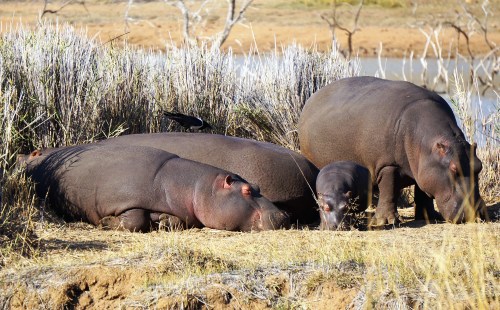
Have you ever heard the myth that the hippopotamus sweats blood? If you look closely at their pictures you may see some of the oily red substance they secrete that was the root of that myth. This substance acts as a moisturizer and sunblock all in one. And under the African sun, we need both!

three hippos (2)

We were lucky enough to watch these fellows basking in the African sun, but we did it safely from a blind. You don’t want to get too close to these guys. They are the most dangerous mammal in Africa and responsible for the most human fatalities in the wild.

DSC06436 (2)

The increase in attacks on humans is primarily attributed to people’s arrogance and disrespect while in the wild. I wouldn’t dream of disrespecting this animal who is capable of chomping a wooden canoe in half. How can a puny human weighing a couple hundred pounds have the audacity to mess with a three-ton animal with a mouth like this? 

Hippo

Google Image

So if you’re ever cruising along a river in Mpumalanga or Limpopo and you’re lucky enough to see these eyes, get your pictures, but do it from a safe distance. If you’re doing that kind of touring, you probably have a zoom lens. Use it!

DSC09058 (2)

This will be my last article on the animals of South Africa–for now–unless someone asks for a particular animal we may have seen in our visits there.  I’d love to hear your comments or opinions on this series, and I look forward to starting a whole new series on an entirely different topic next week.


Read Full Post »

Where Antelope Roam

Let’s look at just a few more of the many antelope that roam in South Africa.

DSC06432 (2)

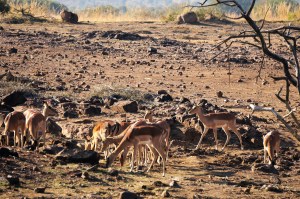
The Impala is one of the most slender and graceful of the antelopes. The female, as you can see in the first picture, does not have horns. The ram, standing tall in the second picture has the recognizable lyre-shaped horns. 

DSC01111DSC02281

Because of the arch-like structure of their horns, they can interlock and throw their opponents.

DSC06645

But their greatest defense against their predators is their speed and amazing ability to leap up to nine feet and cover distances of thirty yards. Here is a link to the image of such a leap.

And then there is the klipspringer–Afrikaans for ‘rock jumper’. The reddish-brown coloring of this small antelope is excellent camouflage for the rocky area which it inhabits. They only stand up to two feet tall and only the males have short horns. Without the zoom lens of the camera, I could barely see these two. I think they’re little beauties.

Clipspringers

The final antelope I’ll share is the magnificent sable.

DSC06343 (2)

Both the male and female of this large black and white antelope species have horns. When attacked by their predators–even lions–the sable will confront them with these scimitar-shaped horns. They often kill the big cats.  This powerful animal is a real beauty.

We’ve been privileged to see these and so many more antelope on our visits to South Africa. Let me know if there are any other species you’d like to see or learn more about.

I’m looking forward to sharing lots of pictures and information on one hungry, hungry animal next time. Guess what it is.

BlondeSig-gkb


Read Full Post »

What is a Kudu?

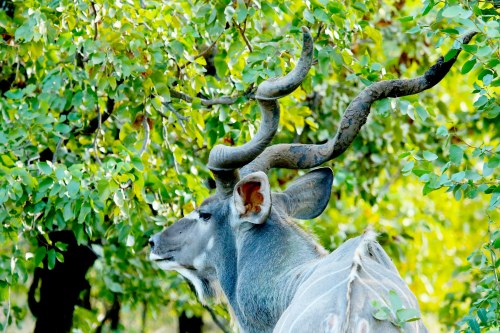
The Greater Kudu is one of the most majestic antelopes in Africa.

DSC02192

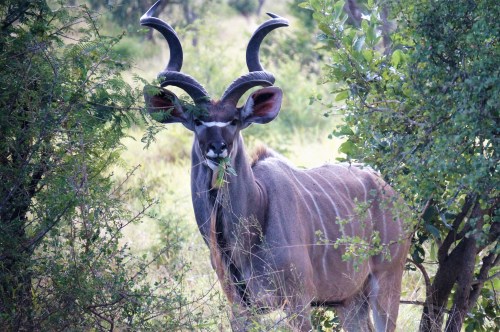
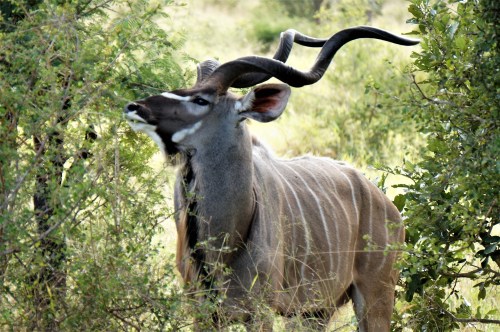
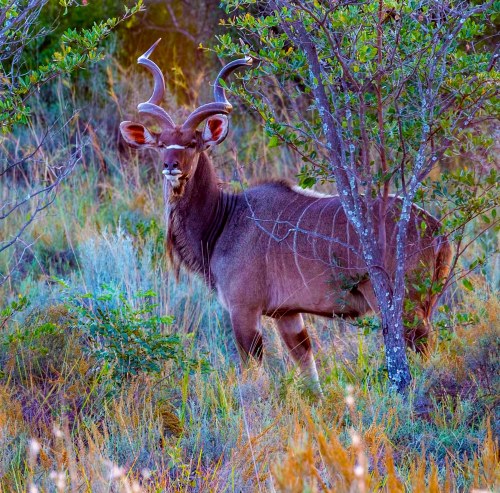
The male kudu weighs up to a quarter of a ton and is easily recognized by its long, spiral horns–the longest of any antelope–and the thin white stripes on its tawny to gray-brown coat.  In a mature male, if those horns with their double twists were straightened, they would average a whopping four feet long. 

DSC02187

Kudu can be caught munching on various trees and shrubs, with their favorites being fruit, pods, forbs and creepers.  However catching them at anything is quite lucky. The kudu is a timid and wary antelope, and I didn’t see nearly as many of them as I did the impala which seemed to be everywhere. But that’s a story for another day.

kudu

My husband, Lee, was fortunate (and skilled) enough to get this wonderful shot of a female kudu. She doesn’t have the magnificent horns, but she certainly has the same big ears.  (Lee won best of show at the York Fair with this picture, and I have to thank him for sharing it with me for this post.)  The female isn’t as large as the male but has the same markings and mane. Isn’t she gorgeous?

kudu-2


Though kudu are distributed widely in South Africa, we found them (with the help of our guides of Van Wijk Safaris)  in dense brush and wooded foothill areas of Kruger National Park and the Province of Mpumalanga. (Final two pictures also courtesy of Lee Bostic, Photography)

kudu-1 

Seeing this magnificent animal in its natural habitat in beautiful South Africa made my heart beat a little faster. Such sightings were such an awesome privilege. It makes the heart long for another chance, another sighting, another breathtaking experience.


Read Full Post »

It’s Primate Time

Monkeys — Baboons — What’s the difference?

Well, just like all roses are flowers, but not all flowers are roses…

roses        sunflower

I preferred watching the antics of the monkeys, but let’s first take a look at the baboons.

DSC02009 (3)

There are five species of baboons, but the one we saw in South Africa was the Chacma Baboon.  It is one of the heaviest, with males weighing from fifty to nearly one hundred pounds, and lives in social groups. These troops did not seem at all worried about the humans driving slowly by.

While the monkeys we will see later are both arboreal and terrestrial, the baboons are not arboreal. You will find them on the ground eating, walking, or hitching a ride. Their diet consists of everything from fruit, leaves and insects to rodents, birds, small antelope, and Vervet monkeys,  They are not looked upon favorably because they will also raid human dwellings to feast on goats, sheep, and chicken.

There are two kinds of monkeys in South Africa — The Vervet and the Samango


Both Vervet and Samango monkeys are arboreal where they have a diet primarily of fruit, leaves, and insects. The Vervet is more common in South Africa and can cause a lot of damage to commercial fruit orchards.

monkey (2)

This shot clearly shows the silver-gray body and black face of the Vervet. Although my pictures show individual monkeys, they are social animals and also live in troops.

monkey drinking (2)

And I was lucky enough to get this little guy quenching his thirst.

As you can see, their usual diet is often supplemented by anything they might find–or steal–from humans. You will find monkeys anywhere people picnic and at many  outdoor restaurants. While stopping for lunch in Kruger National Park, one jumped down and attempted to swipe my food, but Andries Van Wijk moved quickly to intervene. They were both so quick, I barely knew what happened. By the time I spied the little pilferer, he was already looking for his next victim. 

monkey (3)

Next we’ll take a look at some beautiful and fascinating antelopes. Let me know if there is anything else you’re curious about or would like to see.

There is so much to see in South Africa, and with the help of our wonderful guides Andries and Steffi Van Wijk, I look forward to seeing more on our next trip there. 

Read Full Post »

Birds of South Africa

My husband, Lee, and I are not birders, but he is a photographer with a good eye and a ready camera. Fortunately, as we’ve traveled together through Kruger National Park in South Africa (a birders paradise), whenever he spotted a beautiful bird, I would grab my camera and get some pretty good shots myself. My pictures aren’t as exceptional as his, but I enjoyed taking them, and I’d like to share a few with you. So here’s a tiny sampling of a half-dozen of our feathered friends.

1. Lilac Breasted Roller

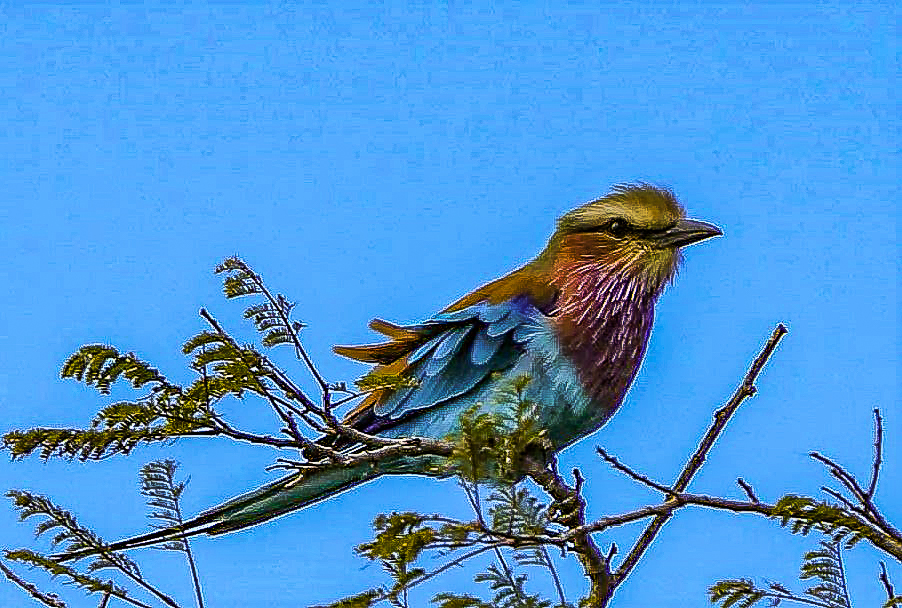
Of the approximately 500 species found in the park, I believe the Lilac Breasted Roller is one of the most beautiful. If you’re in search of this colorfully feathered creature, you will usually find it perched at the top of a tree from which vantage point it can spot its meals of insects, lizards, scorpions, snails, small birds or rodents on the ground.

Lilac Breasted Roller in Flight

I was fortunate enough to catch this one about to take flight. At this angle you can see the beautiful cerulean blue under its wings.

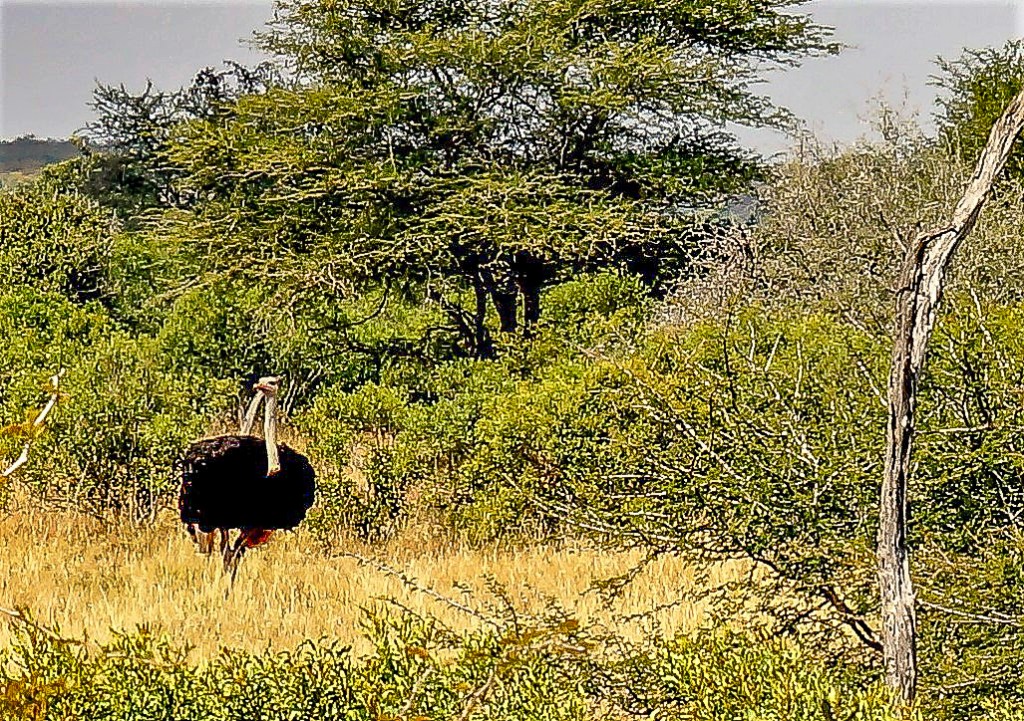
And then there’s Africa’s big bird with its long legs and weighing 140 to more than 300 pounds – the Common Ostrich

2. Ostrich in the wild
Ostrich hanging around the lodge

This large flightless bird is in the order Struthioniformes–yes, I had to look that up–along with kiwis and emus. The ostrich also lays the largest eggs. It has the fastest land speed of any bird and with those long legs can run thirty-five to forty miles per hour. But the ones I’ve encountered were in no such hurry as they enjoy the main source of their diet which is plants.

Now let’s take a look at a bird that’s a little–make that a lot–smaller. The weaver birds range in size from about 4 1/2 to 10 inches long.

3. Weaver Bird

It gets its name from the unique way it uses grass, leaves, twigs and roots to build their nests. You can tell this individual is a male by the bright yellow coloring, and using its beak and feet, it can actually tie knots with these materials. If she approves of it, the female, which is a brown and buff color, will help him to complete it.

4. Martial Eagle

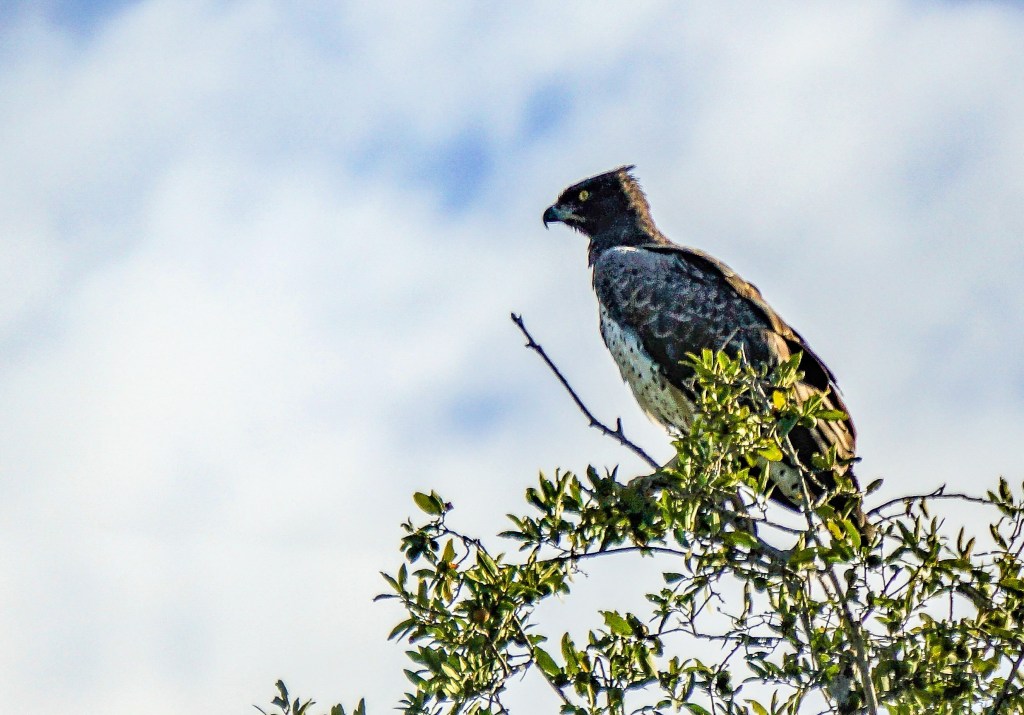
One of the largest eagles, (and the largest in Africa) the martial eagle is an average of thirty-four inches in length with a wingspan of six to more than eight feet. It was a real treat to get a picture of this one. They have extremely keen eyesight, and can spot their prey from as far as three miles away.
You can often see the martial eagle soaring high above hilltops so that binoculars may be needed to get a good look at them.

5. Verreaux’s eagle-owl

And then there’s this unique fellow. The Verreaux’s eagle-owl is the only owl with bright pink eyelids, and he is also the largest African owl measuring up to twenty-six inches long. The fact that it’s nocturnal may explain why he is looking kind of sleepy in this shot. They sleep rather lightly during the day and wake quickly to defend themselves if attacked.

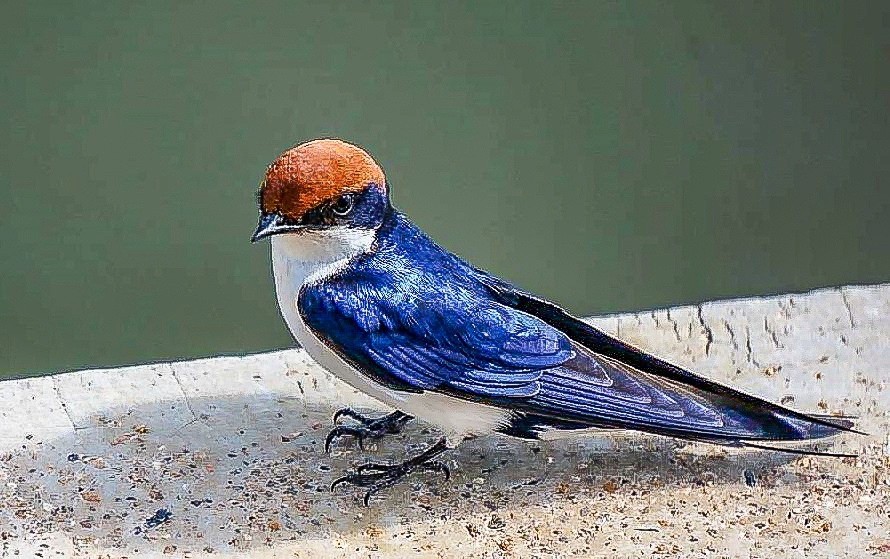
6. Wire-tailed Swallow

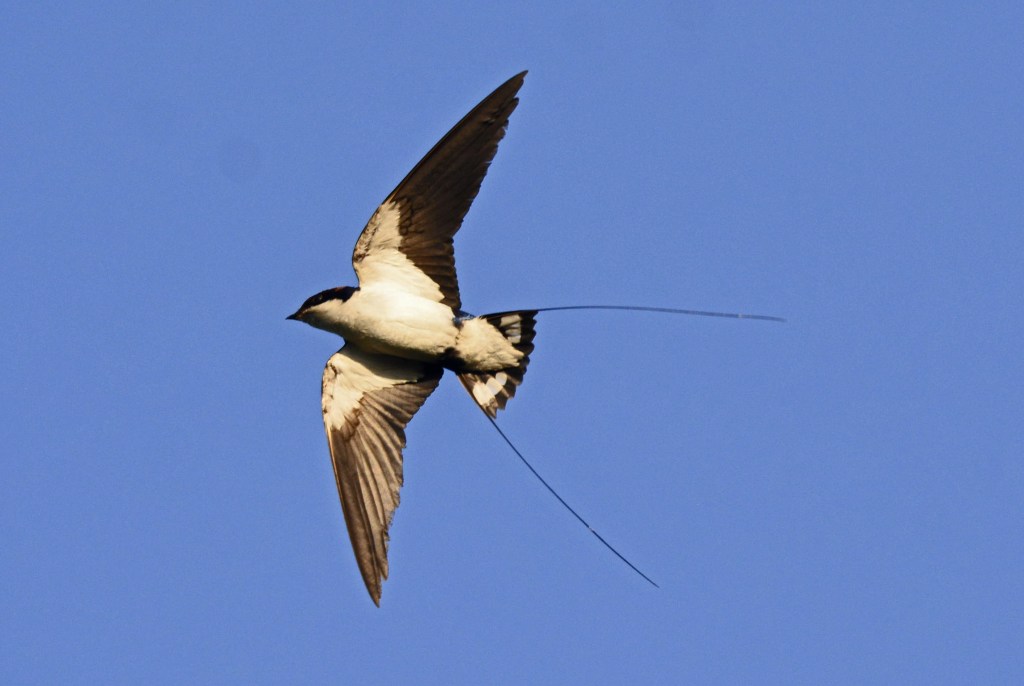
With the bright blue top feathers, the bright white underneath, and the chestnut cap, I think the wire-tailed swallow is gorgeous. He is of course named for the long thin tail feathers that look like two wires trailing behind.

Wire-tailed Swallow in flight
(Google image)

I hope you enjoyed seeing a few of my favorite South African birds. Let me know if you’d like to see more.

Until next time…

Read Full Post »

Giant Giraffe

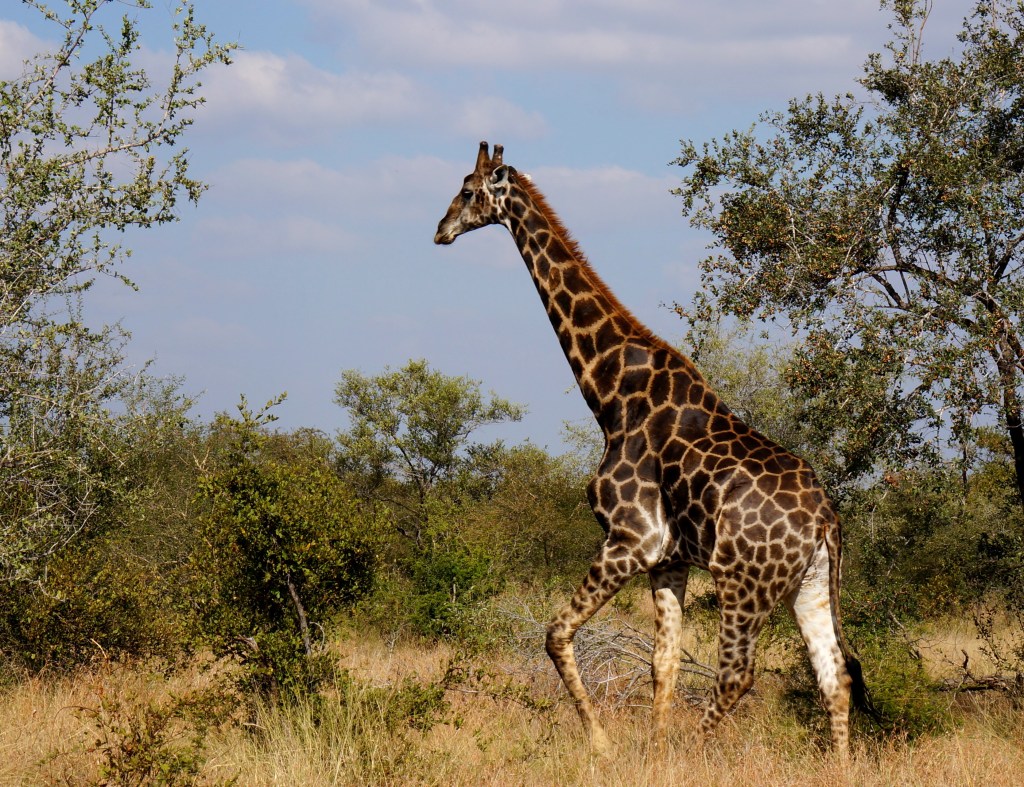
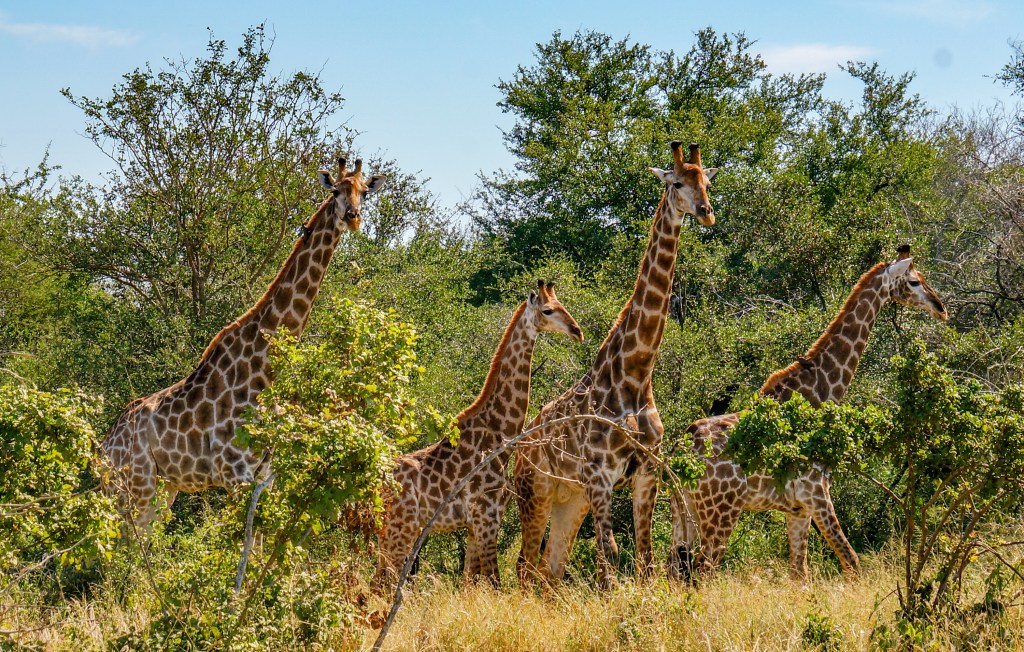
The giraffe is the tallest animal in the world reaching heights of fourteen to seventeen feet.

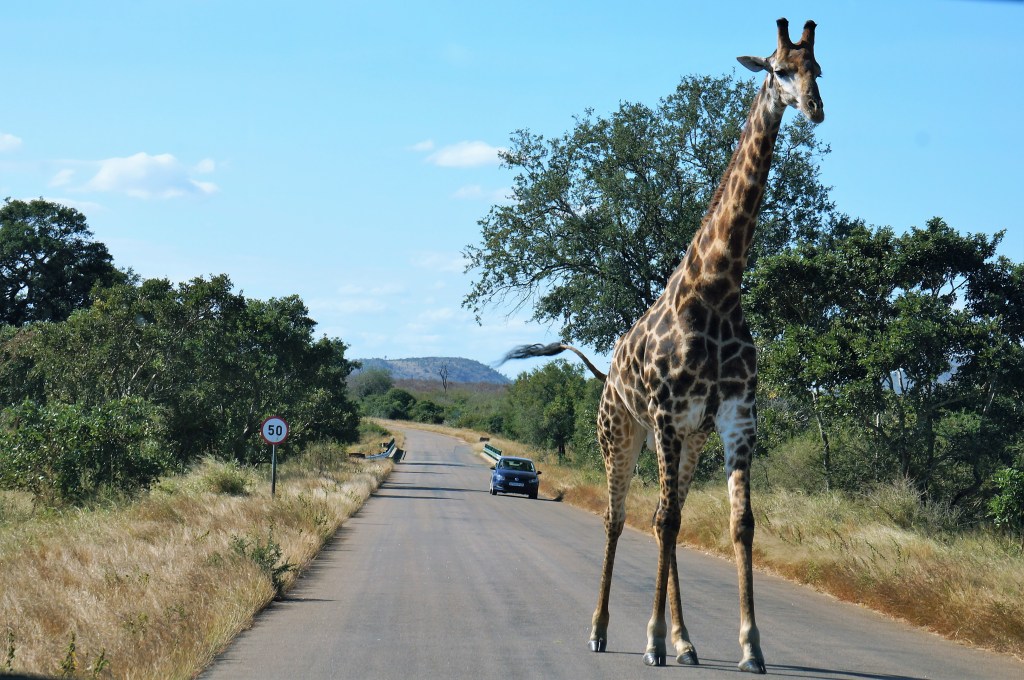
Have you ever stood next to a professional basketball player? Well neither have I, but I have stood next to some men who were 6’3” to 6’5″ and possibly taller. You can get a crick in your neck talking to one of these tall folks—though many are totally worth it—but can you imagine standing next to one of these giants and looking up?

It was simply amazing to see their height as they walked down the middle of the road past our safari vehicle. And driving through Kruger National Park, it is not uncommon to see the giraffe with his head above the trees snacking on leaves from the top of the branches. A whole lot of food goes down that long neck as they eat up to 64 pounds of tree twigs, grass and fruit a day.

This gentle giant may be a vegetarian, but the lion is not, and one of the big cat’s favorite foods is the giraffe. For this vulnerable beast, his best defense against predators is to sleep for only short periods of time—from ten minutes to two hours a day. (That kind of reminds me of my colicky babies first months of life.) Another way this otherwise docile animal can defend itself is by kicking–and he can really pack a wallop.

As we slowly made our way through the park, we were lucky enough to catch a group of giraffes visiting a watering hole, and it’s funny to watch them drink. Because of their height, they must part their front legs to lower themselves to the water. This little guy didn’t have quite as far to go as his elders.

And look at the hitchhikers on this guy. On first glance I thought there was something wrong with him, but upon closer examination (with the help of my camera’s zoom), I realized those were indeed little birds. I later learned these little winged passengers are called oxpeckers (or tick-birds), and they’re feeding on ticks or other parasites.

This unique and strangely beautiful animal is quite social, and if there is anything better than seeing one giraffe, it’s seeing three or four or even five standing tall above the trees like sentries looking out over their domain.

In each of our trips to South Africa, I have discovered its beauty was beyond my wildest imaginings. Many thanks to Andries and Steffi Van Wijk who have been our guides. Van Wijk Safaris never disappoints!

Read Full Post »

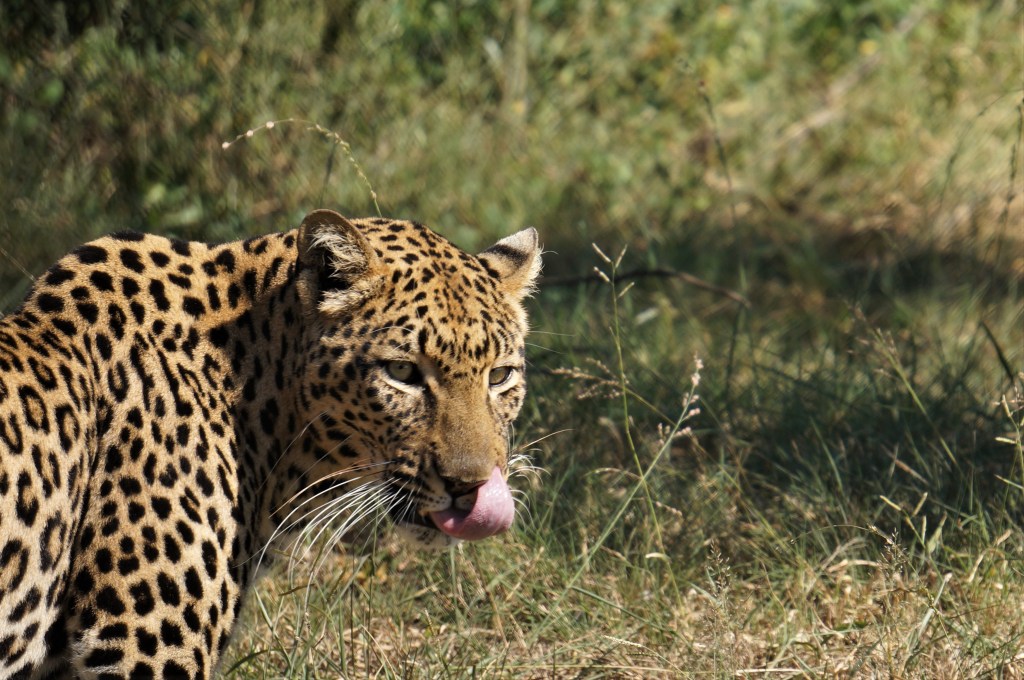
Let’s look at the last three of the “Big Five” starting with the beautiful leopard.

Next to the lion, the leopard is the biggest of the African cats and perhaps the quietest. You won’t hear him roar. At most this silent creature will give the occasional cough-like call.
The leopard is a solitary animal. Male and female only spend a brief time together when mating, and then the male takes off. The female, of course, then raises the cubs on her own

If you recall, I said in a previous article it takes a bit of luck to actually get to see the lions, even at Kruger National Park. Well, it takes a whole bucket-load of luck or good fortune to actually spot a leopard. They lurk in the bush or rocky kopje (or koppies—small hills) usually hunting in late afternoon or at night.

They stalk or ambush their prey, getting as close as they can, and then, with a burst of amazing speed, pounce on it. They quickly end it, biting its neck and dragging it off. They carry it up to low lying branches in a tree to keep it away from scavengers and dine at their leisure.
We’ll be heading back to South Africa in a few months so wish us luck—maybe we’ll spot one this trip.

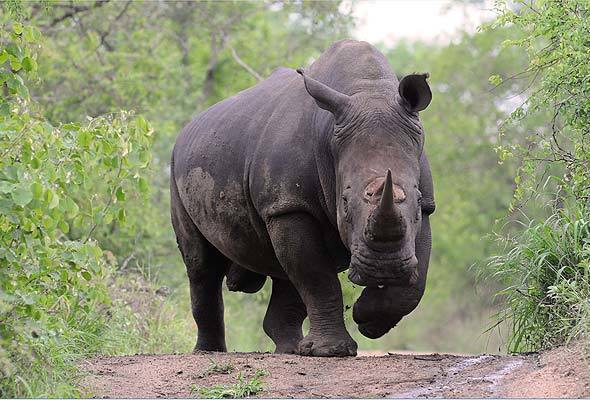
But we’re much more likely to spot this big guy–the White Rhino.

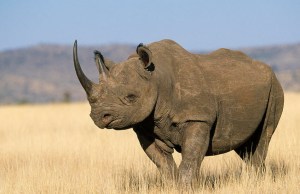
The white rhino and the black rhino are close to the same color which is gray. So how can you tell them apart? Take a look at the lip.

    Black Rhino – notice the pointed upper lip

                                                     White or Square-lipped Rhino

1-white-rhino-gc590aThe white rhino is primarily a grazer and not as aggressive as the black rhino, but looking at the horns (which are actually densely packed fibers–not real horns), I don’t believe I’d like to tangle with either of them. And in spite of their stubby little legs and massive bodies, they can run remarkably fast for short distances.
                                                 So don’t get too close!

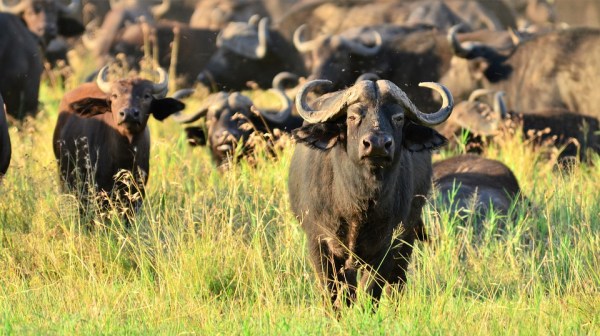
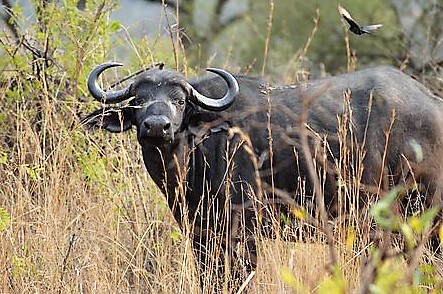
Now, if you spend any amount of time in South Africa, I’m sure you’ll get to see the African or Cape Buffalo.
buffalo-2529508__340 (2)

But probably not this up close and personal. And not usually all alone. Since they are gregarious, you will more often see them running in herds of hundreds. Their grazing behavior changes the long grass lands into shorter grassy areas for other animals to graze upon.

buffalo-4450318_960_720 pixabay
(Picture courtesy of Pixabay)

So there’s a look at the Big Five, but there is so much more to see in South Africa. So many more animals. So many birds with amazing colors like I’d never seen before. So I’m not finished yet. 
There’s more to come!


TT


Read Full Post »

The Great Gray Gift

dsc01786-2My last post discussed the lion–the first of the “Big Five”–but now let’s take a look at the BIGGEST of the “Big Five,” the elephant.
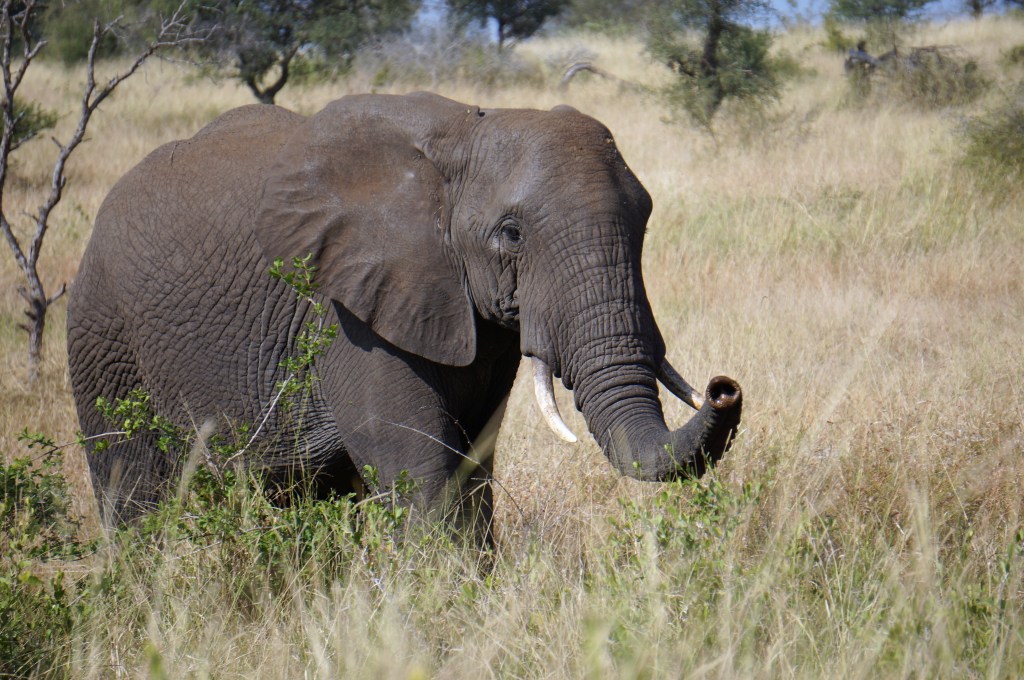
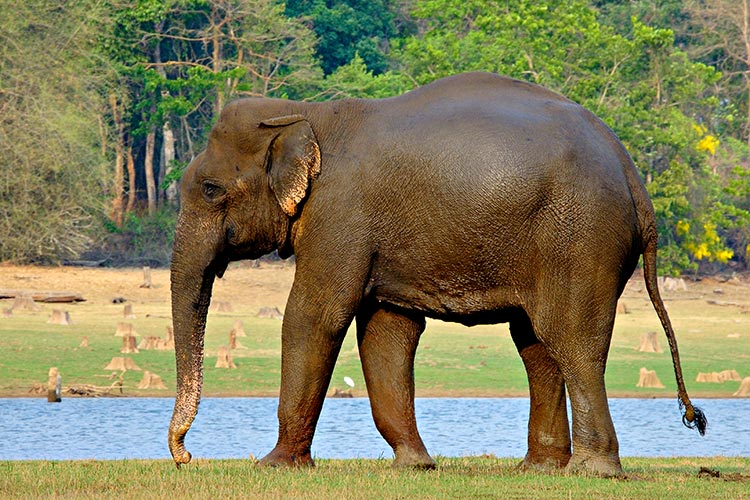
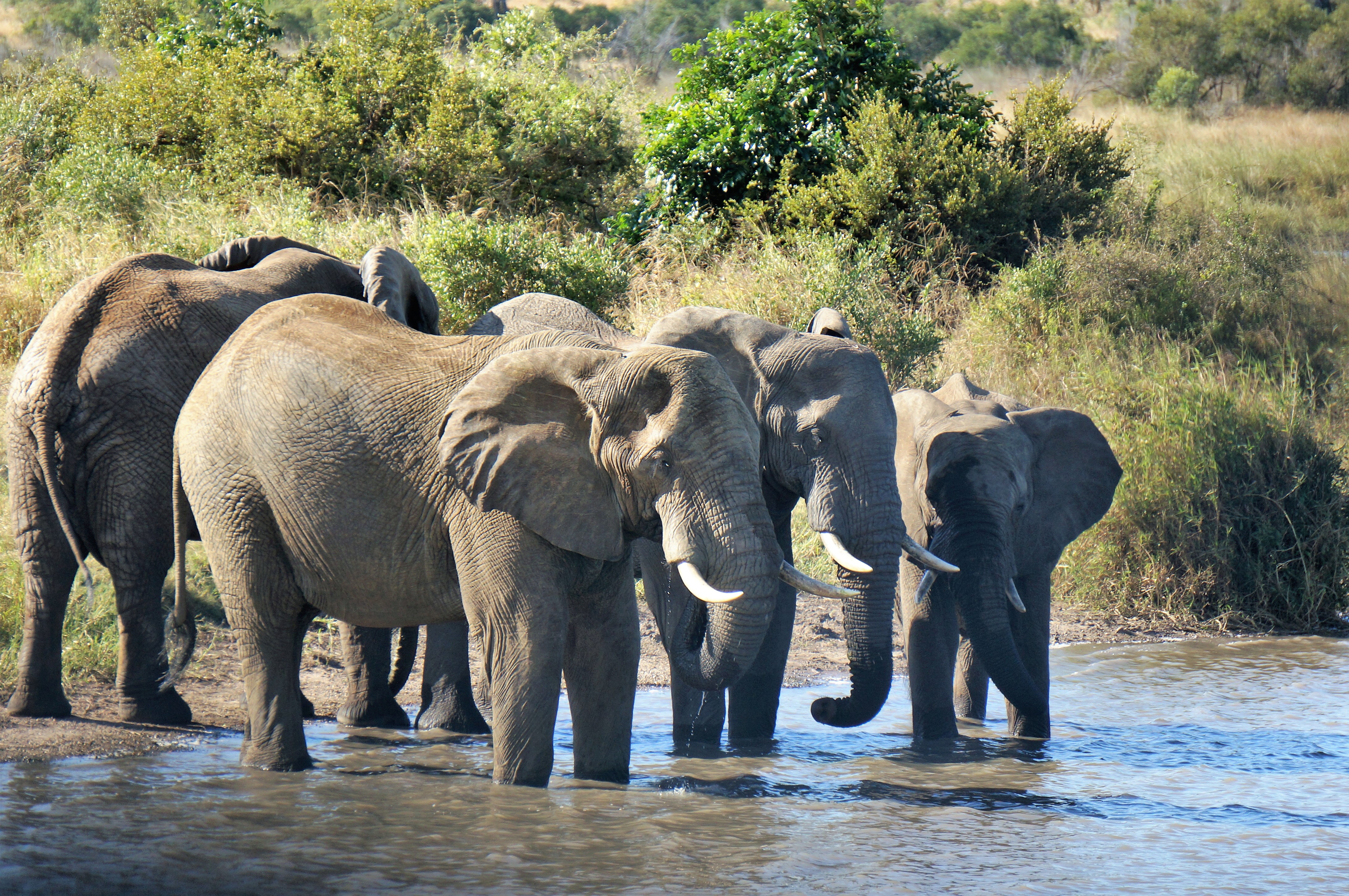
The African elephant is an herbivore, feeding on grasses, creepers, herbs, leaves and bark and is the largest living land animal on earth. Bulls reach a shoulder height of up to 13’ while the females are about 8 1/2’. Both male and female have tusks, which erupt when they are 1–3 years old and continue to grow throughout life. 

We can easily differentiate the African elephant from the smaller Asian elephant by its much larger ears which he uses both to cool himself and to get rid of pesky bugs.

Most of us have seen this gigantic beast at the circus or in a zoo, but no matter where you see them, they are usually eating.

I suppose that’s not surprising since they may consume up to 600 pounds of food a day. But for me, having seen them in the circus didn’t begin to compare to seeing them in their own environment—

—especially when they were at play.

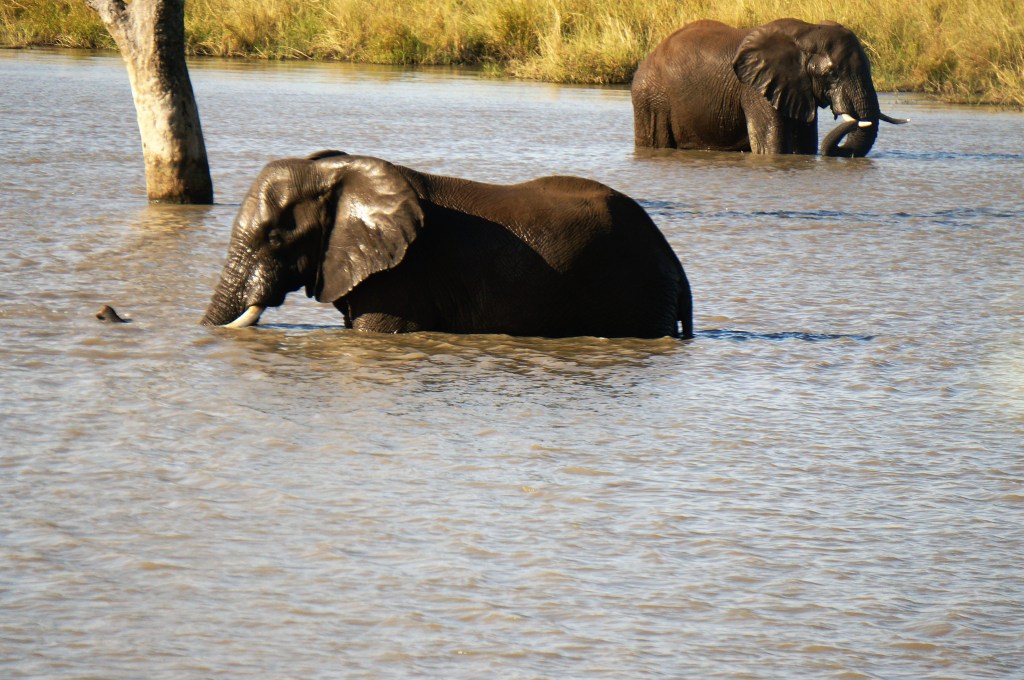
Or simply finding relief from the African sun by chillin’ in the cool water.

The African Elephant population has been declining dramatically across the continent. Thank goodness for places like Kruger National Park which protect large herds. Because of these parks’ conservation measures, the Elephant population in South Africa has grown from about 120 in 1920 in 4 locations, to 10,000 at 40 locations to date.  They’re going to stay around, and that’s an amazing gift for which I am thankful.

DSC02157 (2)

That’s two of the Big Five down, and three to go.

To be continued...


Read Full Post »

A Close Encounter

In 2014 Lee and I made our second trip to South Africa with a side trip to Kruger National Park to see and photograph more spectacular African wildlife. I was excited by the prospect of what we were about to see but had no idea how exhilarating it would become.

Kruger is one of the largest game reserves in Africa and covers an area of 7,523 square miles in the provinces and Limpopo and Mpumalanga. There is a huge variety of animals in Kruger, including the “Big Five”–lion, leopard, elephant, cape buffalo, and rhino–and we were anxious to spot them all.

Detailed Map of Kruger NP

We were driving along with our friends (and guides) Andries and Steffi Van Wyjk when Steffi grabbed her camera and exclaimed, “Lions!” It took a moment before I saw them, but when I did, my jaw dropped and my heart quickened. There in front of us, coming right down the middle of the road, came a line of eleven female lions.

They continued coming until they passed right by our vehicle. They couldn’t have been more than three or four feet from us. Our hearts were hammering and four cameras were clicking furiously as they meandered on by. Not everyone is fortunate enough to have such a close encounter with a pride. This wasn’t the entire pride I’m sure since there were no males with them, but perhaps these ladies were on the hunt. It is the females, after all, who are the hunters.

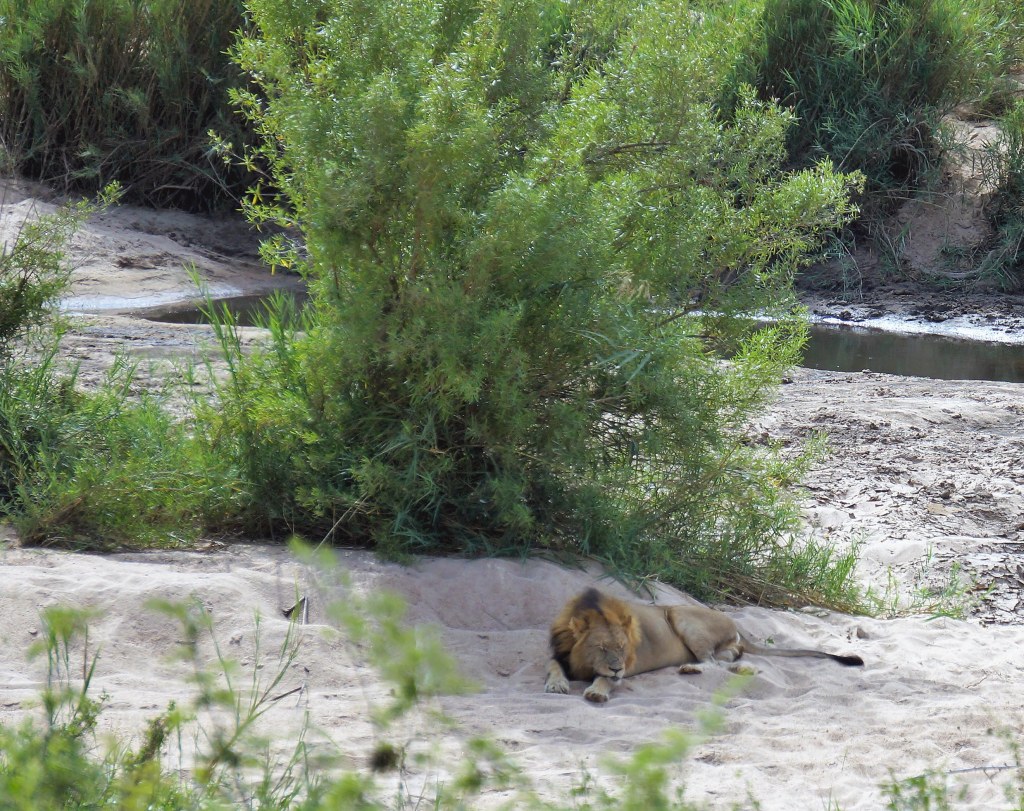
Later in the day, we finally spotted the king of the jungle. He’d found himself a nice little shady spot for his cat nap, and though he was quite a distance away, it was a thrill to see him. Seeing these magnificent animals at home in their own environment is an honor and a privilege.

Nap Time

So, one of the “Big Five” down and four to go.

To be continued…

Read Full Post »

« Newer Posts - Older Posts »

rachelmankowitz

The Cricket Pages

The Wickeds

Wicked Good Mysteries

gettingcozymyyeardiscoveringagatharistiech

Another blog with Kimberly Kurth Gray

The Writings of G. K. Bostic

An author's thoughts on life...

Bob Mayer

New York Times Bestselling Author

Bev Stiffler Smith - Children's Author

A lady and her mischievous little dog

Deborah Riley-Magnus, Writeaholic

Author & Author Success Coach

Becoming an Author

Yvonne Schuchart's Blog

Year of the Book

...YOUR Book!

EasternPennPoints

The Official Blog of the Eastern Pennsylvania Chapter of SCBWI

The Laughing Housewife

Sharing the laughter